
Strict makhana moisture control is the difference between a successful shipment and failure; I have watched a container get turned away at a UK port because someone trusted their eyes instead of a moisture meter. That single decision cost the exporter close to two years of relationship-building with a distributor who had, until that moment, been ready to place a standing order. This is the reality of the fox nut trade right now: demand is exploding, shelves in Austin and London are stocking makhana like it’s the next quinoa, and none of that matters if your numbers are wrong.
Table of Contents
I have spent enough years around processing floors, laboratories, and freight forwarders to say this plainly: moisture is the single variable that decides whether your shipment survives the journey.
Get it wrong, and a premium batch turns into a damp, moldy liability somewhere in the middle of the Pacific, long before it ever reaches New York or Sydney. Get it right, consistently, and you build the kind of reputation that keeps buyers coming back without you having to chase them. Here’s what actually goes into getting it right.
Why Makhana Moisture Decides Whether You Stay in Business
Picture makhana for what it actually is at a molecular level: a sponge with a crunchy shell. It wants water. That’s just its nature. Dried correctly, it delivers the sharp, satisfying snap that Western buyers are willing to pay a premium for. Let it pull in even a little extra ambient humidity during processing or packing, and you’ve introduced a problem that will compound for weeks.
Excess moisture invites fungal growth. It draws pests. And it quietly breaks down the structural integrity of the popped seed, turning what should be a crisp, premium product into something rubbery and unappetizing by the time anyone opens the bag.
Here’s the part most new exporters underestimate: your container is going to spend somewhere between 30 and 45 days at sea. Inside that steel box, temperature swings between day and night, and between climate zones, create condensation — what freight professionals call “cargo sweat.” Load your product in warm and slightly damp, and by the time it reaches port, you’re not shipping food anymore. You’re shipping a write-off. That’s how you lose a buyer, a deposit, and a reputation in a single transaction.
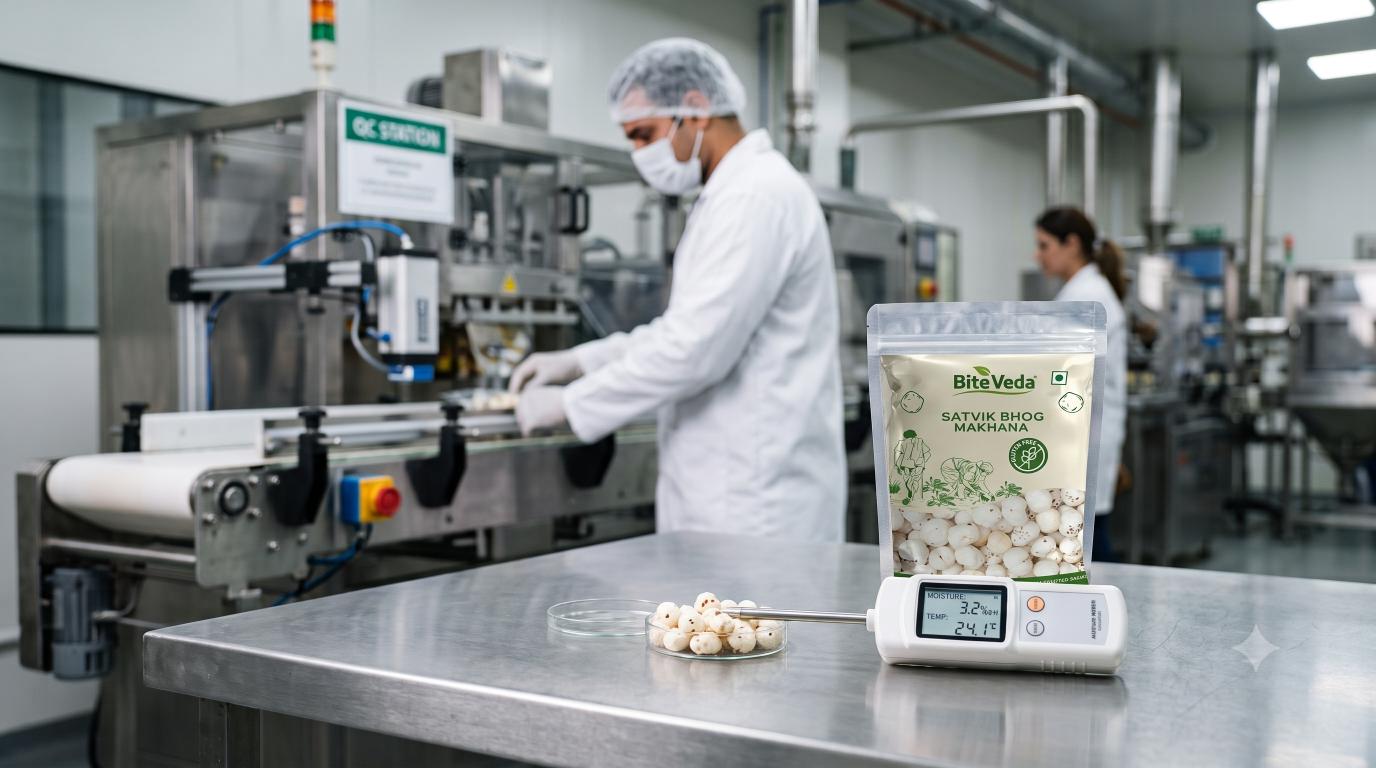
What International Buyers Actually Require: Makhana Moisture Content Standards
International trade doesn’t run on trust. It runs on documentation and standardized metrics, and border agencies — the US FDA, the UK’s Food Standards Agency, and their equivalents elsewhere — apply those metrics without exception.
| Metric | Export Target Value |
|---|---|
| Ideal Moisture Percentage | 4.0% to 5.0% |
| Maximum Allowable Ceiling | 6.0% (Strict Maximum) |
| Visual Appearance | Milky white, no dark spotting |
| Textural Indicator | Sharp, instant snap upon pressure |
The Baseline Every Global Buyer Expects
Domestic markets across South Asia are more forgiving. Seasonal variation in moisture is often tolerated because turnover is fast and the supply chain is short. Export buyers don’t operate that way. They need uniformity, shipment after shipment, because their entire retail model depends on predictable shelf life.
Border inspectors are specifically looking for product that can sit in a warehouse for months without any chemical preservative propping it up. Test above the accepted threshold, and you’re not looking at a warning — you’re looking at quarantine, or in the worst cases, destruction of the entire lot at the port of entry.
Why Tier-1 Markets Won't Budge on This
Buyers in the US, UK, Canada, and Australia are working within retail systems that expect premium presentation and a long, predictable shelf life. Retailers in these regions run tight inventory cycles, and a bag of fox nuts going stale six months ahead of its printed expiry date isn’t a minor inconvenience — it’s a direct hit to their bottom line through returns and wasted shelf space. That’s precisely why import contracts in these markets tie payment terms directly to measurable chemical and physical specifications, moisture chief among them.
Getting Serious About a Fox Nut Moisture Meter
You cannot manage a variable you’re not measuring precisely, and eyeballing a batch works fine for a roadside trader — it will sink an export operation. You need equipment that produces data you can defend if a buyer ever questions a shipment.
Picking Equipment That Actually Works for This Product
A dedicated fox nut moisture meter isn’t optional if you’re serious about consistent exports. These instruments read internal water content using either electrical resistance or radio frequency capacitance, giving you an almost instant readout.
Here’s the catch that trips up a lot of newer exporters: makhana’s irregular shape and highly porous structure mean standard grain meters — the kind calibrated for wheat or rice — will hand you false readings. You need a device calibrated specifically for popped Gorgon nuts or comparably dense, porous agricultural seeds.
Halogen Analyzers Versus Handheld Probes
Serious operations typically run two tiers of testing equipment side by side:
- Handheld Digital Probes — Fast, practical, and ideal for spot-checking a batch right on the processing floor during bagging. They won’t give you laboratory-grade precision, but they catch obvious problems before they compound.
- Benchtop Halogen Moisture Analyzers — This is your final word before a container gets sealed. The analyzer weighs a sample, applies gentle heat to drive off every trace of moisture, weighs it again, and calculates the exact loss. It takes a few extra minutes, but the number it gives you is close to unimpeachable.
How to Actually Measure Moisture in Makhana (Not the Shortcut Version)
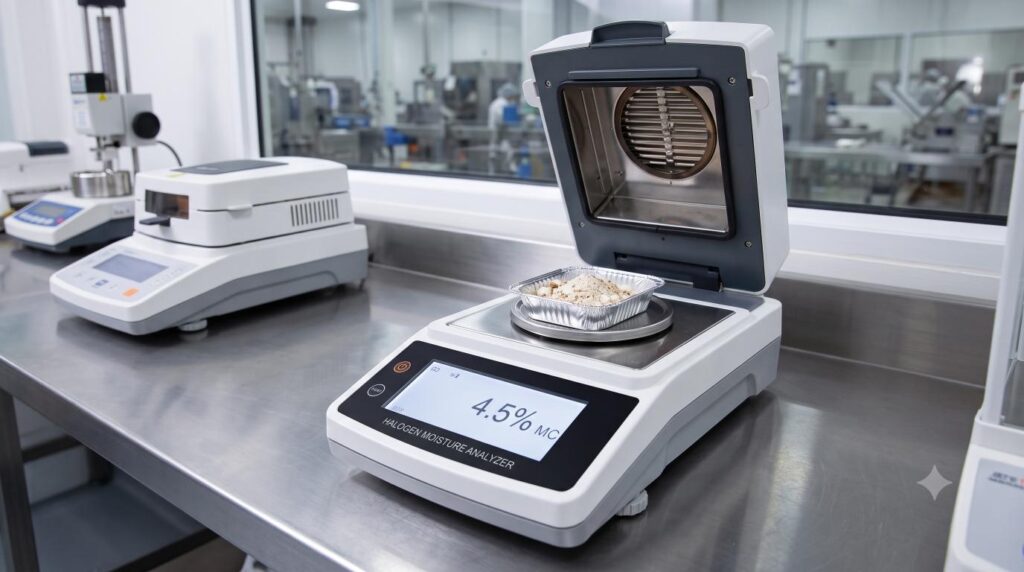
A single seed pulled from the top of one bag tells you almost nothing useful. Accurate moisture testing requires a method, not a guess.
Start by pulling samples from multiple depths and multiple bags — top, middle, and bottom of at least five bags per lot is the practical minimum. Combine these into one composite sample. This is what gives you a number that actually represents the batch, rather than one lucky or unlucky handful.
Before you run anything, make sure your equipment is clean and properly calibrated according to its technical manual. A sensor with residual dust or exposure to ambient humidity will hand you a skewed reading that looks precise but isn’t.
When you’re ready to test, crush the makhana slightly if you’re using a halogen analyzer — this exposes the inner core so the heating cycle can actually reach the moisture trapped inside, not just the surface. Run the cycle until the weight stabilizes and stops dropping.
A habit worth building into your process: log every reading against its specific batch ID. If a buyer ever challenges the quality of a shipment months later, a documented internal testing trail is often the difference between a resolved dispute and a lost account.
Makhana Export Quality Specifications: Where Moisture Fits Into the Bigger Picture
Moisture doesn’t operate in isolation. It’s one input feeding into a broader matrix of specifications that buyers evaluate together when they draft a contract.
Size grading carries real financial weight. Premium buyers pay top rates for larger flakes, typically graded by millimeter diameter — 5+ or 6+ grade commands the best pricing. The tradeoff is that larger flakes have more surface area relative to their volume, which means they absorb ambient humidity faster than smaller, denser grades. A batch that passes moisture testing today can drift upward faster than you’d expect if it’s sitting in a humid storage room.
Discoloration and spotting are treated as serious red flags, not cosmetic quibbles. Rust spots and residual seed coat fragments typically need to stay under 1% to 2% of total batch volume. High internal moisture accelerates yellowing of what should be pristine white flesh, and that visual defect is often enough on its own to trigger a rejection at inspection.
Purity and foreign matter limits get enforced aggressively by customs agencies on both ends of the shipment. Dust, insect fragments, shell remnants, and micro-debris all need to be effectively absent. Properly dried makhana is easier for processing machinery to clean — the shell hardens and separates more cleanly, whereas damp product tends to hold onto shell fragments or break apart under the same mechanical shaking.
The Optimum Moisture Window for Makhana Export
If you want the single number to anchor your entire process around, here it is: the optimum moisture for makhana export sits between 4.0% and 5.0%, and that range isn’t arbitrary.
Drop below roughly 3.5%, and the makhana becomes brittle to the point of fragility. Ocean freight involves constant low-level vibration for weeks on end, and overly dry flakes will grind against each other in that environment. What arrives at the destination port isn’t a bag of premium fox nuts — it’s a bag half-filled with broken fragments and fine dust, and no buyer is paying premium rates for that.
Climb above roughly 5.5%, and microbial risk increases sharply, not gradually. Staying inside that tight one-percent band is what lets your product hold its crunch, resist breakage during handling, and remain commercially stable for a shelf life of 12 to 18 months — which is often the exact figure written into export contracts.
Building Moisture Checks Into Every Phase of Your Pipeline
Consistent moisture control isn’t a single checkpoint. It has to be threaded through your entire operational flow:
Harvesting and Initial Sun-Drying → Machine Roasting and Mechanical Popping → Quality Inspection and Grade Sorting → Final Dehumidification → Hermetic Multi-Layer Export Packaging
- Raw Seed Intake. Test the raw Gorgon nut seeds before they ever reach the roasting pans. If your starting material came in saturated because of poor upstream storage, you need to adjust your roasting time to compensate, not assume the standard cycle will fix it.
- Post-Popping Cooling. The moment popping and shelling finish, move the flakes into a humidity-controlled cooling room. Packing makhana while it’s still warm creates immediate internal condensation inside the sealed bags — a mistake that shows up weeks later as spoilage, not immediately.
- Pre-Packaging Audit. This is your last real gatekeeper. Pull samples directly from the packaging line right before sealing, not from a batch tested hours or days earlier.
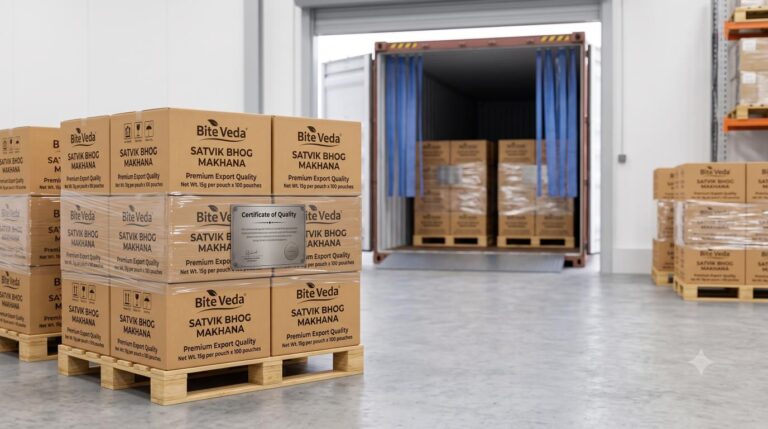
- Sealed Storage. Keep packed cartons elevated on pallets, away from concrete floors and exterior walls, both of which can leach ambient dampness into your outer cardboard over time.
A Proactive Strategy Beats a Reactive One
Measuring moisture accurately only solves half the problem. You also need packaging and handling that actively keeps moisture out from the moment testing is done until the product reaches the buyer’s warehouse.
Multi-Layer Packaging Isn't Optional at This Scale
Standard plastic bags are not built for international freight timelines. Serious exporters use multi-layer laminated pouches combining oriented polypropylene (OPP), aluminum foil, and low-density polyethylene (LDPE) — a layered barrier that dramatically slows water vapor transmission compared to a single-layer bag.
Desiccants Are Cheap Insurance
Don’t cut corners on silica gel or container-grade desiccants. High-capacity calcium chloride desiccant poles placed inside the shipping container actively pull ambient moisture out of the air during transit. It’s a small line-item cost against the very real risk of catastrophic cargo sweat ruining an entire container.
| Protective Layer | Core Operational Function |
|---|---|
| Multi-Layer Laminated Pouches | Keeps ambient humidity out |
| Aluminum Foil Barriers | Blocks light and air transmission |
| Container Desiccant Poles | Absorbs internal cargo sweat |
| Elevated Wooden Pallets | Prevents moisture leaching |
What Skipping a Test Actually Costs: A Realistic Scenario
Consider an exporter shipping a 20-foot container of 5+ grade makhana out of Bihar toward a distributor in London. Under pressure to hit a shipping deadline, the team skips the final laboratory moisture check, assuming the sun-drying phase had already done the job.
The container spends four weeks at sea, moving through several different climate zones along the way. Unknown to anyone on the shipping team, the batch’s actual internal moisture was sitting at 7.2% — well above the safe ceiling.
When the London distributor opens the container, the smell hits before anything else. The flakes, which should be pristine white, show scattered black mold spotting, and the crisp bite that justified the premium price point is simply gone.
The buyer rejects the shipment on the spot. The exporter absorbs the full product loss, pays steep fees for destruction at the port, and loses a business relationship that took roughly two years to build — all traceable back to a fifteen-minute verification step that got skipped to save time.
A Practical Compliance Checklist Before You Seal the Container
Run through this before any container leaves your facility:
- Calibrate your moisture testing equipment against a known standard sample.
- Pull composite samples from the front, middle, and back of the inventory batch.
- Confirm the average moisture level sits safely between 4.0% and 5.0%.
- Verify the packaging room’s ambient relative humidity stays below 40%.
- Confirm all shipping cartons are stacked on clean, dry wooden or plastic pallets.
- Install industrial-grade desiccant bags inside the ocean container before sealing.
The Bottom Line
A dominant position in the global makhana export market isn’t won on volume or price alone — it’s won on precision. Buyers in Tier-1 markets are willing to pay premium rates, but only for product that consistently respects the moisture thresholds their own regulatory systems demand.
Invest in the right testing equipment, build moisture checks into every stage of your process rather than treating it as a final formality, and understand exactly what customs agencies in your target markets are measuring for. Do that consistently, and rejected containers become a rare exception instead of a recurring cost of doing business.
Frequently Asked Question's ( FAQ's)
Q1: Why do international customs agencies reject makhana shipments based on moisture content?
Ans: Border agencies like the US FDA and UK Food Standards Agency enforce strict biosecurity and quality compliance rules. When makhana moisture exceeds the safe limit (above 6%), the high-humidity environment inside ocean shipping containers triggers rapid fungal replication and mold growth during transit. Customs authorities flag this as a major public health hazard and biological contaminant, leading to instant quarantine, rejection, or destruction at the port of entry.
Q2: Can I use a standard agricultural grain moisture meter for testing makhana?
Ans: No. Standard grain moisture meters are calibrated for uniform, high-density commodities like wheat, rice, or corn. Because popped makhana has a highly irregular shape, low mass, and an intensely porous internal structure, a standard grain probe will give completely inaccurate or fluctuating readings. You must use a digital moisture meter specifically calibrated for popped fox nuts (Gorgon nuts) or utilize a benchtop halogen moisture analyzer for unimpeachable data.
Q3: What happens to the physical quality of makhana if the moisture content drops below 3.5%?
Ans: While higher moisture causes mold, over-drying makhana below 3.5% makes the popped seeds structurally brittle and fragile. During 30 to 45 days of ocean freight, ocean vessels experience constant, low-level mechanical vibration. If the makhana is over-dried, the flakes will crush and grind against each other inside the packages, turning a premium batch into a commercially worthless bag of broken fragments and fine dust by the time it reaches the destination.
Q4: How does larger makhana size (e.g., 5+ or 6+ mm) affect moisture management?
Ans: Premium 5+ and 6+ mm makhana grades command the highest market prices but require significantly stricter humidity controls. Because larger flakes possess a much higher surface-area-to-mass ratio relative to smaller, denser grades, they act as highly efficient ambient moisture sinks. They will pull water vapor out of a humid processing or packaging room much faster, requiring rapid post-popping cooling and immediate hermetic sealing to maintain specification compliance.
Q5: What is the most reliable commercial packaging standard to maintain makhana dryness during transit?
Ans: Single-layer plastic bags possess high water vapor transmission rates (WVTR) and fail completely on long international sea routes. The industry gold standard is multi-layer laminated pouches combining Oriented Polypropylene (OPP), Aluminum Foil, and Low-Density Polyethylene (LDPE). This multi-barrier matrix completely blocks light, air, and external humidity, securing the 4.0% to 5.0% optimum moisture window for a stable shelf life of 12 to 18 months.