Where It Started: A Problem We Couldn’t Ignore
Walk into any general store in India and pick up a packet of spices or a bag of dry fruits. Chances are, what’s inside isn’t quite what the label promises. Adulterated masalas and low-grade dry fruits have quietly become the norm rather than the exception, and the people paying the price are ordinary households who just want to cook a decent meal without worrying about what’s mixed into their turmeric or whether their almonds have been sitting in a warehouse for two years too long.
That gap between what people deserve and what they’re actually getting is the reason Bite Veda exists.
The dry fruits market has its own version of this problem. Good quality stock does exist, but by the time it passes through multiple hands — collectors, wholesalers, distributors, retailers — the price has climbed so high that “premium” and “pure” become luxuries most families can’t justify buying regularly. Meanwhile, the farmers who actually grow these products often see the smallest share of that final price.
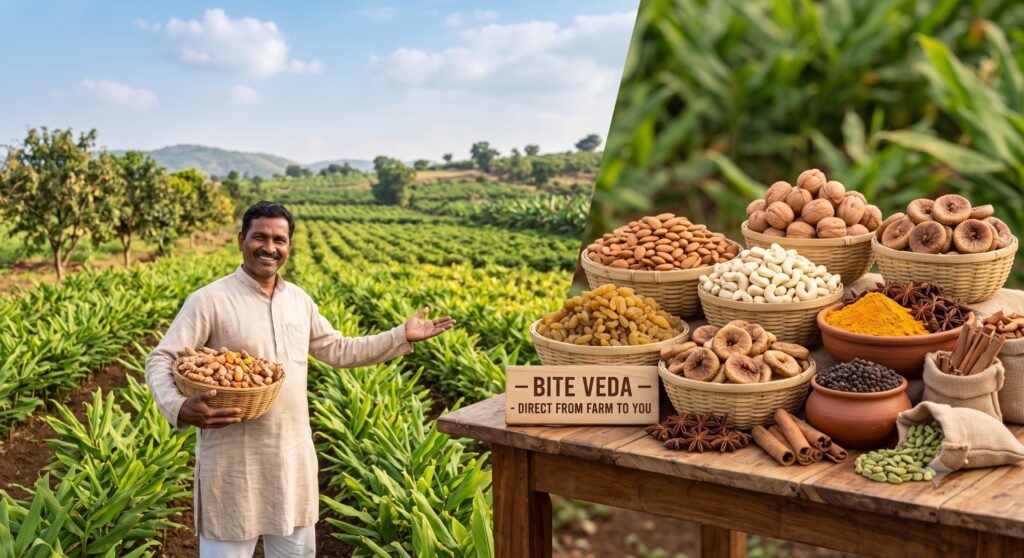
Table of Contents
Where It Started: A Problem We Couldn’t Ignore
Walk into any general store in India and pick up a packet of spices or a bag of dry fruits. Chances are, what’s inside isn’t quite what the label promises. Adulterated masalas and low-grade dry fruits have quietly become the norm rather than the exception, and the people paying the price are ordinary households who just want to cook a decent meal without worrying about what’s mixed into their turmeric or whether their almonds have been sitting in a warehouse for two years too long.
That gap between what people deserve and what they’re actually getting is the reason Bite Veda exists.
The dry fruits market has its own version of this problem. Good quality stock does exist, but by the time it passes through multiple hands — collectors, wholesalers, distributors, retailers — the price has climbed so high that “premium” and “pure” become luxuries most families can’t justify buying regularly. Meanwhile, the farmers who actually grow these products often see the smallest share of that final price.
Our founding logic was simple: cut the chain, not the quality.
Instead of buying from mandis (wholesale markets) or relying on middlemen and agents, we made a decision early on to work directly with farmers. No dalals, no unnecessary layers between the soil and the shelf. This single choice does two things at once — it protects the farmer’s margin, and it protects our ability to control both quality and price from the very source.
Sourcing and Quality: Why We Go Where the Farmers Are
Direct sourcing sounds good on paper, but it comes with a real operational cost — and we’ve chosen to absorb that cost rather than pass it on to either the farmer or the customer.
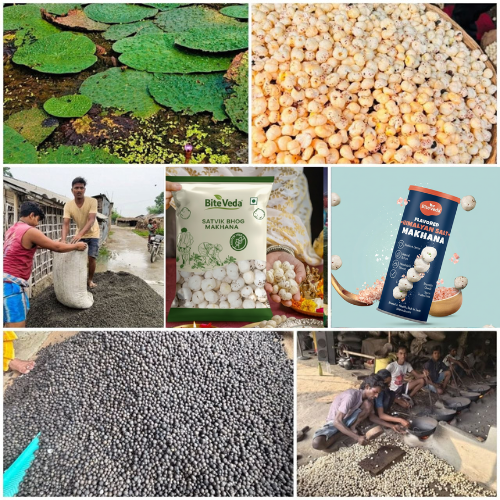
Because we work directly with growers instead of aggregators, our team physically travels to different states to build these relationships. In several cases, we’ve gone a step further and set up processing units close to the source itself. This isn’t a marketing gimmick — it’s a logistics decision that pays off in three specific ways:
- Lower transport overhead, since the product doesn’t need to be shuttled between multiple regional hubs before processing
- Tighter price control, because we’re buying at origin rather than at inflated mandi rates that already include a middleman’s cut
- Better quality assurance, since we can inspect, negotiate, and process closer to harvest, before quality has a chance to degrade in transit or storage
Consider what this looks like in practice. A batch of makhana or a particular spice harvest doesn’t sit in three different warehouses accumulating dust and losing aroma before it reaches a processing facility. It moves from the farm to our own processing point in a much shorter chain, which matters enormously for products where freshness and aroma are the entire point.
We’ve held onto one non-negotiable principle through all of this: quality doesn’t get compromised, even when it costs us margin. In a category where cutting corners is easy and often invisible to the end customer, that’s a harder discipline to maintain than it sounds — but it’s the one thing we won’t trade away for a better quarter.
What “Bite Veda” Actually Means
The name isn’t decorative. It’s a compressed version of the entire brand philosophy.
“Bite” is straightforward — it’s about food, about the physical act of eating. “Veda” points to something older and more deliberate: the Vedic tradition of preparing food with care, where spices were hand-ground and makhana was hand-roasted specifically to preserve aroma and flavor rather than rush the process for volume.
That’s the throughline we wanted the name to carry. In Vedic-era food preparation, purity and taste weren’t separate goals — they were the same goal, achieved through patience and manual craft rather than shortcuts. We wanted Bite Veda to be a reminder, every time someone sees the name, that taste and purity are not up for negotiation. It’s a short name and a traditional one, chosen precisely because it doesn’t need explaining to feel familiar.
The People Behind It
Every brand story has a moment where frustration turns into action, and ours centers on Anshul Mishra, the founder who kept running into the same wall — spice adulteration on one side, mediocre dry fruit quality on the other, with no brand in the middle actually solving both problems at once.
Rather than sit with that frustration, he brought the idea to a close friend, Akash Shakya, who came on board as co-founder. Akash’s focus within the company has been spice — specifically, protecting the taste and aroma profile of every batch that goes out, which is exactly the kind of specialized attention a category like this needs. Adulteration and quality inconsistency aren’t problems you solve with good intentions alone; they need someone paying close, technical attention to sourcing and processing at every stage.
Who Bite Veda Is Actually For
The audience isn’t a single narrow segment — it’s anyone who has stopped trusting the default option on a supermarket shelf.
That includes:
- Households, particularly the women managing daily kitchen decisions, who want assurance that what they’re cooking with is genuinely pure
- Fitness-focused consumers, for whom dry fruits aren’t a snack but a functional part of their nutrition — meaning quality and freshness directly affect the value they’re getting
- Premium lifestyle buyers, who are willing to pay a fair price for a product that’s honest about what’s inside it, rather than the cheapest option that cuts corners
What connects these groups isn’t income level or lifestyle — it’s a shared frustration with a market that’s made purity feel like a premium feature instead of a basic expectation. That’s the gap Bite Veda was built to close.