

A lot of people wonder if this is just a marketing gimmick or if it actually makes a difference to the consumer.
As exporters who spend our time on the ground dealing with the makhana supply chain every single day, we can tell you it matters a lot. How your makhana is sorted directly decides whether you get a good crunch, how many broken pieces are at the bottom of the bag, and whether you’re going to accidentally chip a tooth on a hard shell.
How Makhana is Made (And Why It’s Never Uniform)
To understand the sorting problem, you have to understand how makhana comes to life. Around 90% of the world’s supply comes from the wetlands of Bihar, India. Harvesting it is incredibly tough work. Farmers spend hours waist-deep in mud just to scrape the seeds off the pond beds.
After harvesting, the seeds are washed, sun-dried, roasted over open wood fires, and then popped manually by hitting them with wooden mallets. That hard black outer shell cracks open, and the white puff pops out.
Because this is a completely natural and manual process, the seeds don’t pop evenly:
- Some turn into perfect, large, round white puffs.
- Others split awkwardly, or come out small, or keep pieces of the hard black shell stuck to them.
Because every single piece turns out differently, sorting (or grading) is the most important step in the whole business.
Where Machines Fall Short
To handle massive volume, big commercial factories use automated machines, conveyor belts, and optical color sorters that use cameras.
The process sounds simple: makhana slides down a chute, cameras scan the pieces, and if the sensor detects a dark color, a quick blast of air shoots that piece off the conveyor belt.
While it sounds efficient, automated sorting has a few major flaws:
- The Blind Spots: A camera can only scan what is facing it. If a sharp piece of black shell is tucked inside a fold or sitting underneath the puff, the machine misses it completely, and it goes straight into the packaging.
- Size Doesn’t Equal Quality: Mechanical sieves sort purely by width. If a makhana is large but completely hollow, rotten inside, or rock-hard, the machine still passes it through as “Premium.”
- Product Damage: Makhana is incredibly brittle. The constant vibration of industrial machinery and the high-pressure air blasts break perfect, large puffs into tiny fragments, leaving you with a lot of dust and crumbs at the bottom of the bag.
The Value of Hand-Sorting
When a brand uses ‘Hand-picked’ makhana, it means they rely on experienced workers who check the crop piece by piece.
Here is what actual human inspection changes:
- Real Shell Removal: The black outer shell of a makhana seed is woody and incredibly hard. Human sorters roll the puffs in their hands; they can feel the hidden shells and pick them out manually.
- Spotting the Bad Batches: A worker who knows the crop can tell immediately by touch if a piece is hollow, spoiled, or unpopped (locally called ‘Thuddi’), and discard it.
- Protecting the Crunch: Gentle manual handling keeps the delicate air pockets inside the makhana intact. This is what keeps the snack genuinely light and crispy.
Understanding Makhana Sizes: The ‘Suta’ Scale
In the trade, we don’t measure makhana in millimeters. We use a traditional Indian measurement called ‘Suta’, which determines the grade and pricing:
- Jumbo Premium (5+ Suta / 19mm+): The highest grade. Large, bright white, round, and completely dry. This is what you want for premium snacking.
- Standard Large (4 Suta / 15mm – 18mm): Good average size, commonly used by brands making flavored or seasoned makhana.
- Medium/Low (3 Suta / 11mm – 14mm): Smaller, harder pieces. These usually get ground into makhana powder or used in health supplements.
- Kaddi/Pieces (Below 3 Suta): Broken bits and fragments. Mostly used for curries, sweets, or animal feed.
If you are buying makhana to roast and eat at home, always look for 5+ Suta (Jumbo). Aside from the texture, larger pieces hold seasoning much better. When you toss them in olive oil, salt, or spices, the flavor sticks to the puff instead of dropping straight to the bottom of the container.
The Breakdown: Hand-Picked vs. Machine-Sorted
- Texture: Hand-picked gives you a consistent, light crunch. Machine-sorted packs often contain a mix of soft pieces and rock-hard ones.
- Safety: Hand-sorted means almost zero chance of biting into a hard black shell. Machine-sorted always carries a risk of hidden shells.
- Waste: With hand-picking, you get 100% edible snack pieces. With machines, you often lose up to 10% of the bag to powder and crushed bits.
- Local Economy: Hand-sorting provides direct seasonal employment and income to rural families in harvesting regions, whereas machine processing concentrates the margins at large industrial plants.
What We Do At Bite Veda
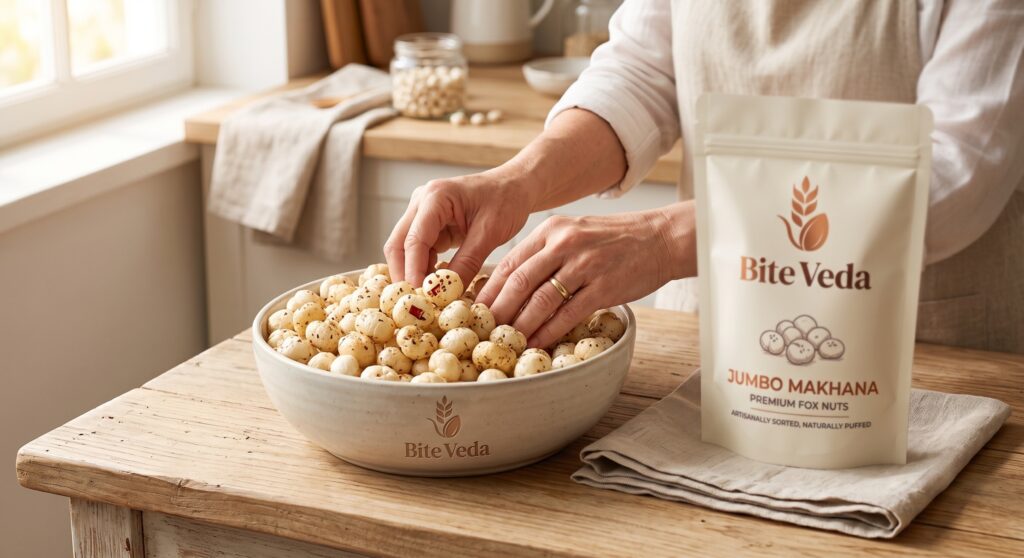
At Bite Veda, we don’t buy our stock from hands-off, fully automated factories. We work directly with local processors and farming communities in Bihar. We don’t believe in sacrificing the actual quality of the food just to hit industrial speeds.
Every batch of our Jumbo 5+ Phool Makhana goes through a double hand-sorting process by experienced workers. We do this to make sure that when you open a bag of Bite Veda, you actually get what you paid for—large sizes, clean pieces, and a proper, crisp crunch.