In the rapidly evolving landscape of global functional foods, Phool Makhana (Fox Nuts) has officially transitioned from a traditional Indian fasting staple to an international elite superfood. Once confined to localized regions like Mithila in Bihar and parts of Uttar Pradesh, this popped water lily seed is now dominating the healthy snack aisles of premium retail stores worldwide. To understand this global shift, our comprehensive “Top Countries Importing Indian Makhana (2026 Report)” reveals exactly which nations are driving this massive international demand.
According to recent trade data, India firmly commands over 90% of the global makhana market, dispatching more than 25,000 Metric Tons (MT) annually. The fiscal value of these exports has crossed an impressive ₹255 Crore (~$30.5 Million), exhibiting a spectacular 27% Year-on-Year (YoY) growth trajectory.
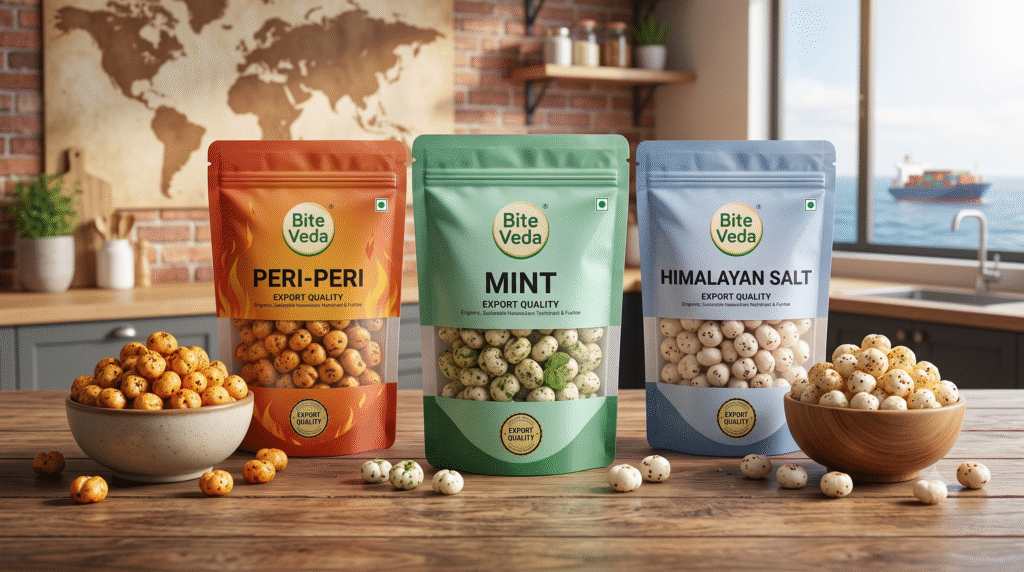
Driven by the global explosion of the plant-based, gluten-free, and clean-label movements, international buyers are aggressively importing high-grade Indian fox nuts. This comprehensive 2026 trade report dissects the top importing countries for Indian makhana, analyzing what drives their demand, their preferred quality standards, and the lucrative opportunities available for modern agro-exporters.
The Global Superfood Paradigm Shift
The international snack industry is experiencing a massive behavioral pivot. Consumers are actively discarding deep-fried, preservative-laden snacks in favor of low-calorie, nutrient-dense alternatives. Makhana naturally fits this premium narrative. Boasting a low Glycemic Index (GI), high magnesium content, rich antioxidants, and a robust plant-based protein profile, it has successfully captured the attention of health enthusiasts, vegan communities, and diabetic patients globally.
To better understand the logistical flow of this commodity, it is crucial to look at how different international regions absorb Indian exports.
Comprehensive Breakdown of Top Importing Indian Makhana Importing Countries
1. The United States: The Undisputed Market Giant
The United States remains the crown jewel of India’s makhana export network. It single-handedly accounts for a massive 40% market share of total Indian makhana exports, absorbing roughly 2,000 MT of the product annually.
-
- Primary Demand Drivers: The primary catalysts in the US are the deeply entrenched vegan, keto, and gluten-free lifestyle choices. Mainstream American consumers view makhana as a high-protein alternative to traditional popcorn and potato chips.
-
- Consumer Preferences: The US market is highly focused on premium quality. American buyers exclusively look for 6 Suta (18–21mm) or larger Jumbo grades. Furthermore, there is a massive surge in demand for value-added variants, such as roasted makhana flavored with white truffle, Himalayan pink salt, or white cheddar.
-
- Market Insight: To penetrate the core US retail ecosystem, USDA Organic certifications, non-GMO verifications, and strict FDA-compliant clean-label packaging are absolute prerequisites.
2. Canada: The Multicultural Powerhouse
Canada stands strong as a top-tier destination for Indian fox nuts, consistently ranking as the third-largest buyer by value.
-
- Primary Demand Drivers: Canada’s robust demand is powered by a twin engine: a vast, affluent South Asian diaspora that retains deep cultural ties to traditional foods, and a rapidly expanding demographic of urban health-conscious locals.
-
- Market Trends: Canadian consumers are exceptionally conscious of corporate ethics and clean processing. They heavily favor transparent, eco-friendly packaging and brands that promise ethical sourcing directly from Indian farmers. The average import pricing in Canada hovers comfortably around $15.80/kg, making it a highly profitable market.
3. The United Arab Emirates (UAE): The Strategic Middle Eastern Gateway
The United Arab Emirates represents a crucial, high-volume corridor for Indian agri-exports, capturing roughly 17% of the total export volume.
-
- Dual Role Market: The UAE acts as both a destination and a massive logistical transshipment hub. While the huge expat population inside Dubai and Abu Dhabi creates direct retail demand, local merchant networks re-export substantial volumes into the broader GCC region, including Saudi Arabia, Oman, Qatar, and Kuwait.
-
- Product Preferences: While premium grades find a home in elite hypermarkets like Carrefour, Spinneys, and LuLu, the UAE also absorbs significant quantities of 4 Suta and 5 Suta (12–18mm) grades for commercial snack processing and blending. Traditional spice blends like Peri-Peri, Mint Masala, and Tangy Tomato perform exceptionally well here.
4. The United Kingdom: Mainstream Retail Integration
The United Kingdom has transitioned away from treating makhana as a niche item found only in ethnic grocery stores. Today, it is a fast-growing segment in mainstream British health food chains.
-
- Market Dynamics: The UK market strikes an excellent equilibrium between high volume and rewarding export prices, with average realizations touching $20.00/kg.
-
- The Trend: British consumers prefer functional snacking formats. Ready-to-eat, portion-controlled small snack packs tailored for office goers and fitness enthusiasts are highly successful. The demand for zero-preservative, dry-roasted makhana is at an all-time high.
5. Australia: The Clean-Label Premium Frontier
Though smaller in terms of sheer population volume compared to the US, Australia offers some of the highest financial returns per kilogram for Indian exporters.
-
- Value Over Volume: The average export price realized in the Australian market stands at a lucrative $21.00/kg. The fitness culture, cross-fit communities, and wellness cafés across Sydney and Melbourne have embraced fox nuts as an ideal post-workout recovery snack.
-
- Strict Regulatory Barrier: Australia enforces some of the most stringent biosecurity and quarantine laws in the world. Exporters targeting this region must ensure flawless phytosanitary documentation and absolute compliance with non-chemical fumigation standards.
6. Germany and the Netherlands: The European Union Core
Continental Europe is approaching makhana through the lens of longevity and functional medicine.
-
- Germany (The Premium Capital): Germany is the highest-paying market globally for Indian fox nuts. Premium, organic-certified 6+ Suta Jumbo makhana can fetch an astonishing $25.00 to $26.00/kg in German organic supermarkets. The emphasis here is strictly on chemical-free, sustainable farming practices.
-
- The Netherlands (The Euro Hub): Backed by the unmatched maritime infrastructure of the Port of Rotterdam, the Netherlands acts as the central entryway for makhana distribution across mainland Europe, feeding markets in France, Belgium, and Scandinavia.
7. Southeast Asia (Singapore and Malaysia): The Emerging Wave
As urban populations in Southeast Asia battle lifestyle diseases, traditional fried crisps are being rapidly replaced by functional snacks.
-
- Singapore: A trendsetter for the ASEAN region, Singaporean consumers demand aesthetic packaging, flawless quality control, and innovative, gourmet flavor profiles such as salted egg yolk, seaweed, and sweet chili.
-
- Malaysia: An emerging market showing consistent growth, driven by a growing middle class looking for healthy, everyday alternatives to processed corn or potato snacks.
Global Market Analytics at a Glance
To give exporters a clear financial picture of the global terrain, the table below highlights how different makhana grades align with international pricing structures and their ideal geographic destinations: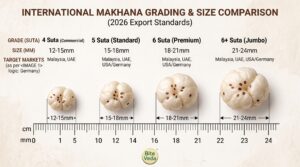
Makhana Export Matrix: Grades, Pricing, and Target Markets (2026 Data)
| Grade (SUTA) | Size Parameter | Average FOB India Price (USD/Kg) | Primary Target Destination Market | Markt Dynamics & Buyer Expectation |
| 6+ Suta (Jumbo) | 21-24 mm | $18-$25 / kg | Germany, USA, Premium EU Retail | Organic certified, zero-defect, maximum puffiness, clean labels. |
| 6 Suta (Premium) | 18 – 21 mm | $15 – $20 / kg | United States, United Kingdom, Canada | High demand in mainstream retail, health chains, flavored snacks. |
| 5 Suta (Standard) | 15 – 18 mm | $11 – $15 / kg | Australia, Canada, UAE Retail | Balanced grade, widely used for private-label packing and snacking. |
| 4 Suta (Commercial) | 12 – 15 mm | $8 – $11 / kg | UAE Hub, Malaysia, Southeast Asia | Price-sensitive markets, heavy volume, ideal for crushing into flour or local roasting. |
Technical Specifications: The New HS Code Regime
For a long time, makhana was exported under generic categories like “other dried fruits” or “swelling cereals.” To streamline international trade and provide direct statistical clarity, global trade authorities introduced dedicated Harmonized System (HS) codes. Every professional exporter must accurately map their inventory to these updated codes:
-
- HS Code 20081921: Exclusively assigned for Popped Makhana (Ready-to-eat, raw, or roasted variants).
-
- HS Code 20081922: Designated for Makhana Flour and Powder (Increasingly used in the international baking, baby food, and nutraceutical industries).
Key Challenges and Strategic Solutions for Exporters
I.Quality Standardization and Size Grading
International buyers operate on strict uniformity. Hand-sorted or poorly graded batches face immediate rejection at overseas ports.
-
- Solution: Indian processing units must invest heavily in automated grading machines that accurately segregate seeds by mechanical diameter (Suta sizing), ensuring zero moisture retention and perfect structural integrity.
II. The Organic and Traceability Mandate
High-paying markets like Western Europe and North America demand transparent supply chains. They want to know exactly where and how the raw seed was harvested.
-
- Solution: Establish direct, traceable contract farming linkages with growers in premier production hubs like Bihar and Uttar Pradesh. Securing certifications from APEDA (Agricultural and Processed Food Products Export Development Authority) and global organic bodies dramatically unlocks premium tier-one pricing.
III. Post-Harvest Preservation and Packaging
Makhana is highly hygroscopic; it rapidly absorbs moisture from the atmosphere, losing its signature crispness and becoming prone to spoilage during long sea voyages.
-
- mSolution: Utilize advanced, multi-layered nitrogen-flushed barrier packaging. This completely eliminates moisture entry and preserves product freshness for extended transit periods across global maritime routes.
The Road Ahead: A Golden Era for Indian Agri-Exports
The future horizon for the Indian makhana industry is incredibly bright. To completely transition the sector from an informal, unorganized trade to a structured global powerhouse, the Government of India has established a dedicated Makhana Board with substantial financial backing. This apex body is specifically designed to aid domestic processors in scaling up infrastructure, securing international quality certifications, and running global B2B marketing campaigns.
The global makhana market is projected to expand at an explosive compound annual growth rate (CAGR) of over 8.8%, targetting a global valuation of $2.23 Billion by 2030.
For forward-thinking brands, processors, and exporters, the message is loud and clear: the global appetite for clean, functional Indian superfoods is insatiable. By focusing on uncompromising quality grading, innovative flavor profiles, and legally compliant international certifications, Indian makhana is uniquely positioned to redefine the global healthy snacking ecosystem for decades to come.